Total Pageviews

Tuesday, 9 August 2011

Green Products I'm Trying:Updated

I'm always looking for day-to-day products (like cleaning products) that are easy to use, that work properly, and also reduce my waste output and the amount of chemicals I bring into my home. I recently found this website Grass Roots Environmental Products that has many interesting products I wanted to try.

Here is what I bought:

Himalayan Soap Nuts 250g for 9.99 (about the size of a medium sized freezer bag)

"For centuries, soapnuts have been used by people in northern Asia to wash their laundry and finest textiles (e.g. wool, silk, cashmere). They have also been used to make cleaning solutions for washing dishes, floors and hair.
Sustainably produced, biodegradable and compostable, soapnut shells are economical and leave your laundry fresh, clean and soft. Soapnuts are gentle on skin and clothes and suitable for sensitive skin, allergy and eczema sufferers."


I haven't tried them yet, but the directions say to place them in the cloth bag provided and place them in the washer with your clothes. I will update this post when I have used them.

I also bought reusable dryer sheets, as I can't live without a static remover, but I also hate buying wasteful products that only add toxic chemicals to the home.

Did you know you are supposed to wash your lint screen with soap and water regularly if you use dryer sheets such as Bounce because they leave a gooey chemical residue behind that blocks up the small mesh of the lint screen and can cause fires?
$14.99
"You'll think your clothes were dried in the breeze!
Static Eliminator is the world's longest lasting dryer sheet system. It eliminates static, softens fabric, and each box lasts an incredible 500 loads (two sheets per box).
Chemical free, safe for sensitive skin and 100% hypoallergenic, these anti-static powerhouses really get the job done."


Reviews of this product say that in drier climates you need to use both sheets per load in order for them to soak up all of the electricity that is conducted during drying. Again, I will write my own reviews after I use them.

I also purchased a portable water filtration system for school, because I hate the taste of chlorine and like to avoid buying water as often as I can. The system is 12.99 and came with some filter replacements, and the replacement filters that last 3 days or 1 gallons of water each, 16 in a pack was 9.99. One set of replacement filters plus the 4 that came with the system should last me both semesters of school.

The system is simply a tiny metal cylinder with holes and 2 plastic ends that hold a carbon filter that looks like a tea bag. Simply drop that into your water bottle and shake, and drink.

So far, since using it at work, it has taken away the taste of chlorine, but not the smell, which is interesting but good enough for me! The tea bags of carbon are compostable as well!


 I have since washed and dried a comforter and it came out clean and static free! Both products are working well.

I also washed a load of towels and cloths and they came out very clean as well, cold water both times.

You can see that the soap nuts do release soapy suds!
Since I think I have somewhat hard water, I put 10 halves in my little bag, and I will continue to use them until I don't see any more suds and write down how many loads that was.


Tuesday, 2 August 2011

Sweet Grass: Wiingash, Hair of Mother Earth, Hierochloe odorata

When the Green Plan went to a Water Conference in Sault Ste. Marie on July 18-21, the theme or the recurring message was always that the youth needed to be taught traditional knowledge, and that the Earth would be better understood and protected if our ways are passed on.

But the #1 question was "How?"

This made me think about how much traditional knowledge I have, and realized its not much. One of the things I always wondered about was sweetgrass and other traditional medicines. When is it appropraite to use? How do you get them? What exactly is each one for? All I had to do was ask one or two people, and I had all of that information.

My coworker Deb showed me how to pick sweetgrass, which I would like to share:

Before you pick a sacred medicine, you need to lay some tobacco and say a prayer of thanks.

 This is what sweetgrass looks like. Its abundant in some spots, but others it will be sparse and harder to see. They seem to like moist, disturbed areas like clay or sandy roadsides where there are other types of wild grasses/cat tails.
 It has a sheen to it, is smooth and thin, and droops over once it gets to a certain height. There is also a purplish colour down near the root, which helps with identification. Also, you can really smell it when you are near sweetgrass:


When you find it, you must pick it one stem at a time, follow the stem down to the ground and try to pull it out at its root

I broke it many times above the root, so the art of yanking it out gently enough so it snaps at the root takes some getting used to.
 The ones that are picked properly have a bit of the root still attached, a small white nub at the end.
After you pick it, you tie a string or a piece of grass around the end of the bundle and hang it to dry for a couple of days. Then you can braid it. If it gets very brittle before you can get a chance to braid it, soak it in some warm water for a few minutes before braiding.

You can propogate sweetgrass by burying pieces of root, as they will grow from a cutting of root. I have also heard of people using seeds. Here is an image of the plant with seeds:


The 3 strands of a braid of sweetgrass represent mind, body, and spirit, and is used to purify our thoughts and carry our prayers to the Creator.

Wednesday, 27 July 2011

Get rid of standing water in your yards!

From the Sault Star Online:

A mosquito has tested positive for West Nile Virus in Sault Ste. Marie.
The insect was caught in a trap last week, said public health inspector Heidi Pittman of Algoma Public Health.
It's the first such confirmation of an insect having the disease in Algoma District since 2005.
"The virus could be present even in all the previous years," said Pittman.
"It didn't end up in the traps so it didn't get identified."
The health unit sprays many concrete electrical vaults in the city with a larvicide twice annually.
When the first spraying was done last week, a "higher than normal" amount of larvae was found, said Pittman.
West Nile Virus is transmitted to humans by the bite of an infected mosquito. There is no cure.
Sources of standing water, such as old tires, unused containers and wading pools, should be removed from residential properties.

Monday, 25 July 2011

What is Precycling?

Sure, recycling is good for the environment in one way, but in others it adds to carbon emissions because it takes energy to recycle, and most recycling plants don't use renewable energy (although many are starting to).

So what is another way, on top of recycling, that can help keep unnecessary garbage out of our landfill?

Precycling is the idea of watching what you buy based on how much waste it's going to create.

A few examples of Precycling:

  • Buying in bulk to reduce packaging
  • Purchasing things with little to no packaging (such as when buying used)
  • Only purchasing that which you are sure your local facility accepts (for instance, our facility will trash any plastics numbered 3-7, so I try to avoid those whenever possible)
  • Choosing quality items that will have a longer life span (rather than something inexpensive yet poorly made and quickly needing replacing)
  • Supporting companies who print on or package with recycled materials
  • Choosing reusable over disposable items
  • Statistics

    Approx. 250,000 plastic water bottles are thrown out every hour.
  • Planning ahead by bringing your own bags (for produce, dried bulk goods, check-out, etc), napkins, utensils, coffee mugs, etc.
  • Making your own yogurt or bread, instead of buying packaged options
  • Wrap gifts with other gifts: a book wrapped within a shirt and a belt as a bow.
  • Avoid the purchase of things you don't really need or that do not serve an important purpose in your life. Surround yourself with inspirational and useful items, rather than more "stuff".
Precycling is the first step in reducing waste, recyclable or not. Keep it in mind when shopping for groceries or gifts. And allow the reduction in waste to make space within your personal life, as well. Because reducing the waste coming and going from our home simplifies our life and reduces the clutter in our own minds as well.

From here

Tuesday, 19 July 2011

The 153 best sunscreens

I know not everyone can order things online, but I find more and more that I have been compelled to order soaps and other things online that I have done research on and I know are safe for my family, especially my toddler. If you do a little reading on the ingredients on the back of most of the things in your bathroom you use on your skin every day, it can be a little scary.

I order soap from this company Druide as they list all of their ingredients and their process for making soap.
This company is also Canadian and Certified Organic under Canadian Standards:   http://www.greenbeaver.com/

A few organic brands of sunscreen may be available in stores like Country Way on Brock Street, but unfortunately most of these are probably only available online.

Here is a list of the 153 best sunscreens to buy in the United States under United States Standards:
153 Best Sunscreens : Safest for you and your kids

You can go to EWG's Cosmetic Database and search any of the sunscreens on this list and find out the pros and cons of each and where to buy them if you like what they have to offer:

EWG's Cosmetic Database

One product that is for children and has a rating of #1 (zero is the best rating you can get from EWG) is Aveeno's Sun Natural Protection Baby SPF 50 Stick, which is probably more widely available than most other products on this list. Its available online at Amazon.com

From this list, I like the stats and ratings on the following products because they comply with The Compact for Safe Cosmetics and their sunscreens have a rating of 1 or better:
http://www.badgerbalm.com/  
http://www.californiababy.com/   
http://www.supergoop.com/  
http://elementalherbs.com/   
http://luvalla.com/
http://mvorganics.com/
http://www.mexitan.com/ 
http://www.poofscloset.com/servlet/StoreFront 
http://www.purpleprairie.com/
http://www.suntegrityskincare.com/Welcome.html 
http://thinkbabybottles.3dcartstores.com/thinkbaby-Safe-Sunscreen_c_21.html
http://www.trukid.com/ 
http://www.organicevolution.ca/uv-natural/ 


Monday, 18 July 2011

Honouring the Water Indigenous Water Forum

This week the Green Plan students are at the 4-day water conference being held in Sault Ste. Marie. It is a great chance to learn about our most important resource that is quickly becoming endangered. You can view a live feed of it every day from 8:30 to around 5pm here: Nation Talk

Thursday, 14 July 2011

Why Everyone Should Grow Something

Everyone should grow some of their own vegetables because:


It's cheaper

It's healthier for you and your family because its pesticide free. Most of us today have lost someone before their time. Disease is no longer a rarity.

You don't have to leave your yard (or house- if you grow indoors) to get it.

You know exactly where it came from.

 Your vegetables will be more nutrient rich because they didn't sit in a truck or store for weeks before you ate them.


 They will taste better.

Gardening is proven to be therapeutic and gives you a sense of accomplishment.

It is educational for your kids.

You can share with family and friends.

It's not as complicated or time consuming as you think.

Thursday, 7 July 2011

Composting:UPDATED: A useful way to recycle and reduce your waste output

"Composting" is nature's way of recycling organic materials that many people harness to reduce their output of waste and make their own nutrient rich soil for gardening, thus saving money and helping the environment.

Microorganisms like bacteria and fungi found outside on the ground feed on organic materials such as dead plants and process them through digestion into premium quality soil components. The best part is, they do it for free!

It is estimated that about 50% of what ends up in plastic bags at the landfill could have been composted! That's a lot of plastic bags!

How to Compost:

1.Pick a sunny spot in your yard.


2.Turn the soil there with a rake or shovel.


This I didn't do, and opted to add a bag of $1.99 soil instead. 


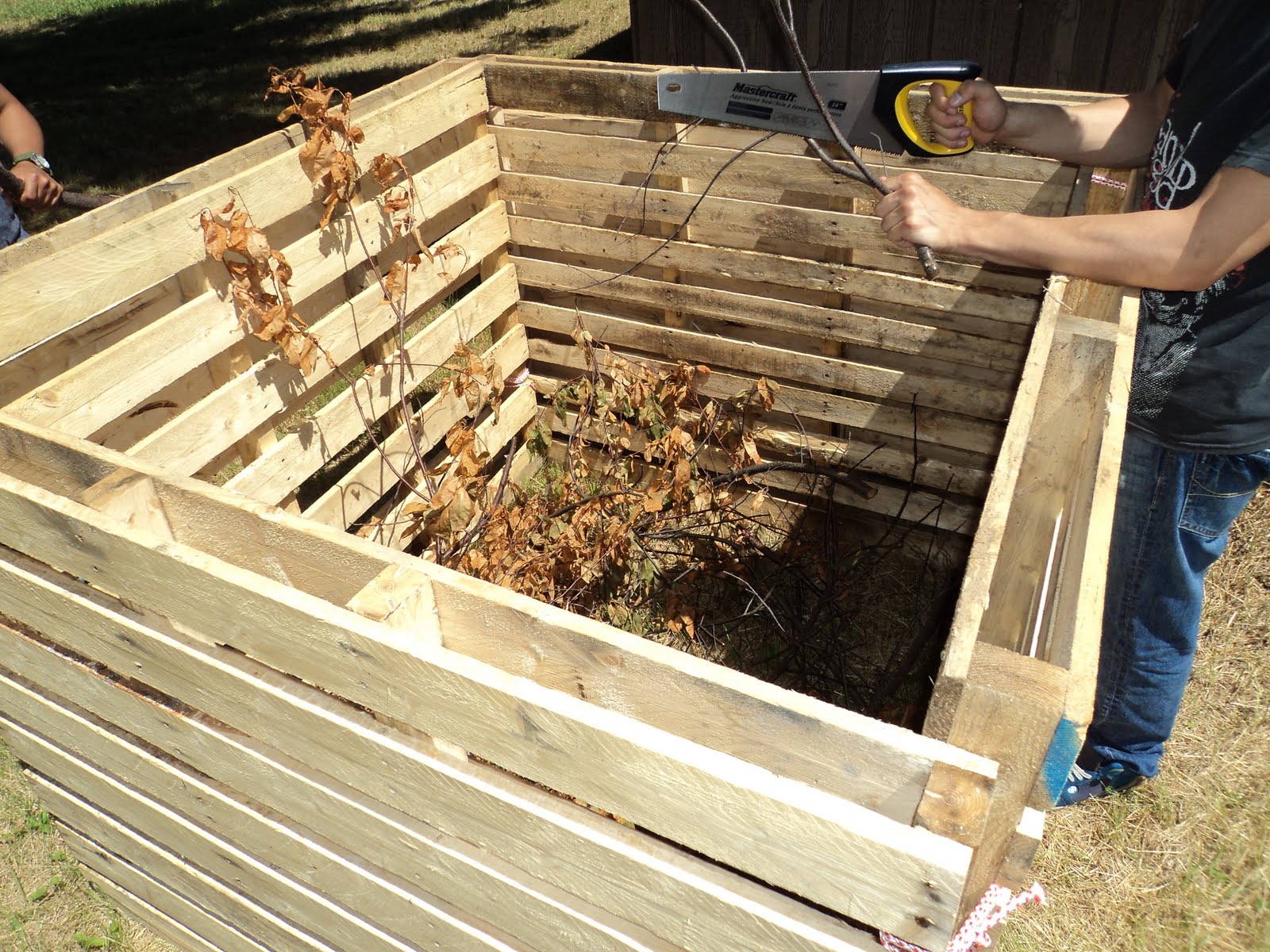
3. Make or buy a compost bin. ( Wooden box, pallets wired together, old fencing, chicken wire and wooden posts, or plastic and metal bins found in stores).


We used 4 free pallets we got from my uncle's work (there are many places in town that just throw them away), some rope for 5 dollars, and a bag of soil to get the process started.


 4. Place the bin on top of your turned soil in your sunny spot.


5. Place a layer of small branches in the bottom  -  this will allow for air movement and drainage

6. If you want, add a bag of bought soil to help the process along faster (not absolutely necessary)

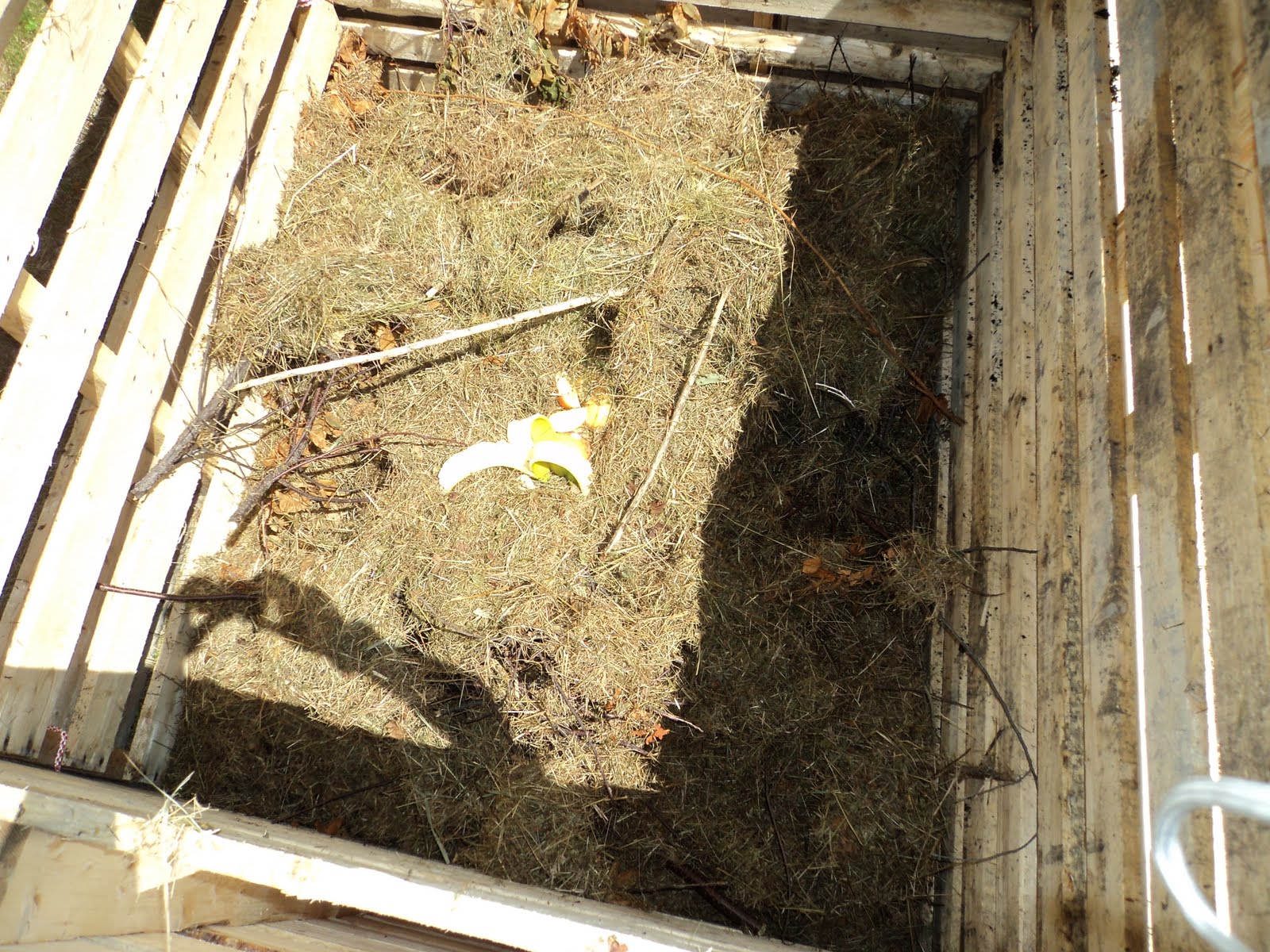
We added grass clippings from after mowing my lawn:


7. For the best and speediest process, alternate between wet and dry layers of material, such as a layer of fruit cores and scraps on top of a layer of leaf litter or newspaper.

We added some old fruit from my house and a peeling from a freshly eaten banana.


What can and can't be composted?

Do compost:
  • Fruit and vegetable scraps (even rotten)
  • Egg shells
  • Fresh grass clippings
  • Fresh weed clippings
  • Dry leaves
  • Straw/hay
  • Sawdust
  • Coffee grounds
    (including filters)
  • Tea leaves (including bags)
  • Napkins
  • Paper
    (recycling is recommended)
  • Pasta
  • Bread
  • Rice
  • Peanut shells
  • Fruit pits
  • Natural fibres (cotton, linen, wool, untreated leather…
Don't compost:

  • Meat and Fish
  • Oil (fat)
  • Bones
  • Dairy products
  • Rhubarb leaves (some sources say it is ok because the oxalic acid, which is toxic to kidneys, is neutralized as it decomposes)
  • Weeds that have gone to seed or with persistent root systems
  • Treated grass
  • Diseased plants or leaves
  • Wood ashes (highly alkaline, will make soil useless for growing plants)
  • BBQ briquettes
  • Animal or human excrements(can contain pathogens)
  • Vacuum dust (unless your home uses all natural cleaning products)
  • Materials contaminated by pesticides or other dangerous products (ex. : treated wood)
  • Large quantities of waterlogged material
Maintenance: Turn your compost once a week with a shovel or other gardening tool. Maintain an even mixture of wet and dry materials.

It can take between 2 months and 2 years to break down materials, depending on temperature and what is added. 

This post will be updated with images from my own first time composting efforts.

Wednesday, 6 July 2011

Green Plan Students Water Sampling

This year we are testing for E. coli at the most common swimming sites including Engine Point, Ojibway Park, Big Bend, Charles Point,  and Bell's Point. So far the water is still quite cold and the E. coli levels are very very low!

Happy swimming!


 Here is Daeson at Big Bend


Here is Cole and Deb at Big Bend


What is E. coli and why do we test for it?

E. coli is a naturally occurring bacteria that lives in the digestive tract of warm blooded animals, including humans, and as such, serves as an indicator of possible bacteria pathogen contamination. It could indicate pollution from sewage and waste water, and the potential that other pathogens may also be present.  Only some strains of E. coli are actually dangerous.

What can high levels of E. coli cause if ingested?:

Gastrointestinal infection symptoms such as diarrhea, vomiting, exhaustion.
Urinary tract infections
 
Sources of E. coli in swimming water:

Illegal waste dumping, septic systems that have overflowed, storms can cause waste water treatment plants to overflow into surrounding water systems, animal waste (such as watefowl) and agricultural runoff.

After a rainfall, E. coli levels will be elevated because of water runoff and the fact that E.coli is a natural bacteria. E. coli levels will only become dangerously high if there is an excess due to the above sources.

For example: So far our levels have been under 30 MPN, and in order to be able to cause illness, levels have to be above 200 MPN. In 3 years of water sampling, the highest number the Green Plan has found was 60, and this was after a heavy rainfall.

Monday, 4 July 2011

What I Did on Aboriginal Day


On June 21, I had the extreme pleasure to go up to Pic Mobert reserve to see a man I have looked up to since I can remember.
My dad used to call to me when I was playing and say "Come and watch this with me, it's interesting." And it was The Nature of Things.
Since then I have wanted a job in the Natural Environment field, especially when it comes to protecting the environment, and thus, protecting people and animals. I thank my father, and David Suzuki for inspiring me. I recorded his entire speech.
 I highly recommend you check it out, as it is a reminder of many things we Aboriginal people have known for thousands of years, and something David Suzuki is very thankful our people have taught him.

This post is dedicated to Christopher Belleau, who told me a great story about meeting David Suzuki that I will always cherish

How Much Water Do You Use?

This is an interesting image:

Shopping Can Help: Composting Toilet

What is a composting toilet?


Some of you may already know what these are, or considered buying one for your camp.

Others may find this idea a little unsettling, as the thought of composting your own sewage sounds, well...gross!

Composting toilets help the environment by effectively converting human waste into helpful and clean soil.

They use little or no water, are not connected to expensive sewage systems, cause no environmental damage and produce a valuable resource for gardening.


By now you may be asking, "What's so wrong with the toilet I have now?" Well, there are a few things.

Besides pit toilets, present toilet systems are either “sewered systems” or on-site “septic or mini-treatment systems.”
Both are based on the principle of using water to transfer the “wastes” to a treatment system. Whether this is a septic tank just outside the house, or a sewage treatment plant 10 miles away, both must treat a large volume of raw effluent.

This historical use of water to “cleanse” away the toilet wastes is where the first problem occurs.

Raw sewage starts to break down by a process that utilises oxygen within the water.

Once this oxygen has been used up, the breakdown of sewage is changed to microorganisms that perform anaerobic (non-oxygen) respiration.

The byproducts of anaerobic respiration are nutrient-rich effluent and flammable methane and other foul smelling gases. This is the traditional smell associated with septic tanks and sewage treatment plants.

 In many cases around the world, untreated effluent is left to run down natural streams and rivers into lakes and oceans. The high nutrient value of the effluent causes algal blooms in these waterways, which as they die and are decomposed by microbes which use up the dissolved oxygen in the water. This in turn reduces dissolved oxygen levels which kills marine animals.
The effects can be quite devastating up the marine food chain.

The waste of another natural resource, clean water, is another problem.

Building expensive dams, piping water hundreds of miles, treating it with expensive processes, and then using 40% of this treated water to flush away a small quantity of human byproducts is utter madness.

Overall, the present system of treating “humanure” is a wasteful and expensive burden on our communities and the environment. To reverse this system, and build a sustainable systems of “waste” re-utilisation is possible using systems such as composting toilets.

The many benefits of using a composting toilet include:

1.Water Use Reduction (20-50%)
.
2.Odour Problems Reduced
The suction air flow in most composting toilets takes toilet and bathroom odor out of the room and acts like a constant extraction fan.
3.Lower Household Maintenance Costs
Draining (around $100) and eventual renewal (in the thousands) of septic tanks is not necessary..
4.End Product Recycled
While only small in amount, the solid end product is a valuable fertilizer that can be utilised around trees and gardens.


Recycling
The composting toilet possesses the ability to recycle much of your household waste. Food scraps, paper, lawn clippings and grease from you grease traps can be composted back through the toilet.
Unusual Sites
Composting toilets can be installed in many different situations which would not accommodate other systems. Rocky sites, high water table, no water storage, environmentally sensitive, close to running watercourses, and swampy ground. All these difficult site situations can be accommodated with a small amount of alteration to the basic system design.

Benefits to the Community & the Environment

Together with the personal benefits of the composting toilet there are overall benefits to the society and the environment.
Water Use
A reduction in water use allows the large capital costs of dams and reservoirs to be spread over a greater population. It also enables decentralised water sources to be used.
Reduced Marine Pollution
Nutrient load on streams and rivers is almost negligible. This results in more oxygen being available in the water and a return to improved activity of marine life.
Pollution Detected Quickly
Without sewage systems to flush away wastes, It would be easier to ascertain where toxic wastes are being leaked into watercourses. Industry would be more willing to rectify these problems if it were easier to identify the sources.
Damage Limited
Miscalculation in individual composting systems has a much smaller impact than the same mistake in a large centralised system. It is also easier to rectify and return to normal operation.
Less Environmental Impact
Compared to sewage systems, on-site composting treatment has less impact on the environment:
• Large effluent releases into watercourses and oceans are avoided.
• Disruption to soils systems through pipeline installation is eliminated.
• Leakage of raw sewage into groundwater through pipe deterioration and breakage is eliminated.

 How do they work?

There are 2 types of composting toilet systems:

BATCH SYSTEMS
With the batch systems, a container is filled and then replaced with an empty container. The composting process is completed inside the sealed container. The system may have a single, replaceable container. Or it may be a carousel system where 3 or 4 containers are mounted on a carousel and a new container is spun into the toilet area when the other is full. After a full cycle is complete, the first container is fully composted and ready for emptying.


CONTINUAL PROCESS SYSTEMS

 These systems are in a constant state of composting. Waste enters the system, composting reduces the volume and moves it downward where it is harvested after 6-12 months as fully composted material.


An example of one sold at Home Depot for $1449:

All Sun-Mar composting toilets incorporate a patented Bio-drum™ which ensures fast and odourless decomposition. Saves thousands of gallons of water, while recycling waste into safe, usable soil. The unit is shipped fully assembled. To install, simply plug into a regular 110V outlet and connect the supplied 2 inch vent stack. Seasonal capacity: 3 adults or families of 4. Residential use: 1 adult or family of 2 (there are larger capacity toilets)


Installation

The installation of a composting toilet requires a venting pipe to be installed that connects to the outside to eliminate odours, and for most older models, you will need a liquid (urine) overflow drain that connects to a tank or goes outside into the ground.

The remainder, dried solids and toilet paper, is easily lifted out and stored outdoors for 6 months inside the container. This process inactivates human pathogens, so that it can harmlessly be composted or buried, in order to decompose fully. The end product is an organic fertilizer in your flower garden.
 Composting toilets are well suited for cabins and camps with a lake nearby that you fish in, as using a composting toilet there will eliminate contamination to the fish you eat and water you use at the camp.

Home installation would require a little more work and dedication, as it is used more often.

There is also a new type of composting toilet becoming available that separates urine and feces and makes a more efficient system. Here is the link: Separatt toilets

Here is a video that shows the finished product soil from a composting toilet and the lady explains a bit about them as well:

Thursday, 23 June 2011

What is a CSA?

A CSA is community supported agriculture.

 
CSA's focus on producing high quality foods for a local community and they often use organic farming methods, which are better for the environment. Organic farming methods use all natural techniques to help produce naturally healthy crops. Where as industrial agriculture uses chemical pesticides and fertilizers in there crop production. These chemicals often leach into the ground water and can have harmful effects on the environment.


Most commonly, they provide a system of food sharing to the consumer for the duration of the growing season. The consumer typically gets a whole season budget for a set number of weeks. The grower and consumer take part in a common-pricing system where they can negotiate the prices and jointly accept the budget. The system provides a guaranteed market for the farmers and it allows for the financing of the farming operation throughout the year. The consumer and growers then both accept the risk and reward of the growing season. 

Vegetables and fruit are the most common CSA crops. However the consumer is only able to purchase what is locally grown. Generally the local CSA will provide delivery, pick-ups or have drop off places weekly or monthly for subscribers. Locally the Algoma Food Network has documented the growth of the local CSA's in the area. An article is available online titled "Community Supported Agriculture" here is the link. 

 Why they are important:
CSA's are another way to reduce the amount of pesticides and chemicals that are brought into our lives through mainstream farming and it reduces the amount of carbon emissions because fresh produce doesn't have to be transported from far away destinations. Also it helps out the local economy.

So if anyone is interested in CSA's locally or needs more info let us know, we want to hear from you.

You can join a CSA by talking to local farmers at the Algoma Farmer's Market, site with info is here

Here is a link to a local farm that sells antibiotic ad hormone free meat: Penokean Hill Farms

Why is antibiotic and hormone free meat better? 
Because of crowding, stress-inducing conditions, and unnatural diets that often occur in the conventional meat and dairy industries, antibiotics are needed to fend off disease. In addition to antibiotics, animals are also given growth hormones— to stimulate year-round high production of milk, for instance. It is estimated that as much as 80-90% of all antibiotics given to humans and animals are not fully digested or broken down and eventually pass through the body and enter the environment intact through wastewater and runoff. When bacteria in the environment interact with these antibiotics, they may transform into more resistant strains that pose a greater risk to both animals and humans. By choosing hormone-free and antibiotic-free meat and dairy products, you can help keep the environment clean and healthy.

The use of rBGH (a hormone that is injected) in cows to increase milk production has shown to cause an alarming rise in the number of deformed calves and dramatic increases in mastitis, a painful bacterial infection of the udder which causes inflammation, swelling, and pus and blood secretions into milk. To treat mastitis outbreaks, the dairy industry relies on antibiotics. Critics of rBGH point to the subsequent increase in antibiotic use (which contributes to the growing problem of antibiotic resistant bacteria).

Milk from rBGH-treated cows contains higher levels of IGF-1 (Insulin Growth Factor-1). Humans also naturally have IGF-1, and increased levels in humans have been linked to colon and breast cancer.
These are good reasons to buy organic and local meat and dairy products, and support your local economy!

Kerry will be attending the Farmer's Market soon and documenting it for the blog. Keep reading!

Monday, 20 June 2011

Tips on driving 'Eco Friendly'

Greetings to all band-members and non band members, my name is Shred_bear and I will be contributing posts to the Garden River Green Plan Blog. I am a Fanshawe College student in the Motive Power Technician - Diesel Truck/Coach program, this weeks post will include how you can be an 'Eco Friendly' Driver. Fossil fuels are the primary cause of Global Warming and millions of humans contribute to the deteriorating health of our planet daily by burning gasoline. Here are a few simple tips for vehicle owners by which they can reduce their 'Ecological Footprint.'

- Obey the speed limit and avoid sudden starts and stops. The faster you accelerate the more gasoline is required to provide the necessary torque to move your car.

- As a general rule of thumb, keep your engine speeds between 1,200--3,000 RPMs, and up-shift between 2,000--2500 RPMs if you have standard transmission.

- Make sure to check your tire air pressure as often as possible. For every 4 PSI of under-inflation, your fuel consumption increases by about two percent.

- Make sure to replace your air filter when need be. Restriction of air to the cylinder (possibly caused by a dirty air filter) can cause the cars computer to increase the air/fuel mixture causing increased fuel consumption.

- Repair air conditioner leaks immediately some AC units contain chlorofluorocarbons which are very bad for the environment.

- Maintain a steady speed If you do a lot of highway driving, consider using your car’s cruise control function. A steady speed decreases gas pedal activity, which saves on fuel.

- Avoid Idling for prolonged periods of time. It is common belief that it takes more fuel to start up the vehicle rather than letting it idle for a few minutes. It actually takes more fuel to start up if you're going to be waiting for more than thirty seconds than if you just shut your car off.

- Get rid of any unnecessarily heavy items in your car such as: tools and hockey equipment

- Driving with fuel economy in mind, or eco-driving, can increase the distance you travel with every tank; track your fuel economy.

- Invest in G-Oil, a new eco friendly engine oil developed in San Francisco. After extensive testing and research, it is finally being marketed for public retail. The Green Earth Technology had this to say about their new product: 

"Change your oil, change the world with Environment Safe, ULTIMATE BIODEGRADABLE* G-OIL® GREEN Motor Oil, the world's first and only American Petroleum Institute's (API) "SM" Certified bio-based motor oil. We blend nature's American grown base oils (domestically sourced beef tallow) with nanotechnology to provide superior performance protection during the maximum oil change intervals recommended by vehicle manufactures while meeting or exceeding requirements.

Our bio base-synthetic G-OIL is the GREEN SOLUTION for gasoline engines, providing better protection for automotive engines under the toughest driving conditions NATURALLY BETTER THAN SYNTHETICS.

Whether "topping off" or returning your used motor oil to a collection center, G-OIL is compatible with all other motor oils."

 Additional information tabs on the website go on to show how using this natural product breaks down in the earth if not properly disposed of.

"According to the US Environmental Protection Agency, over 40% of our nation’s oil pollution comes from the improper disposal of used motor oil by Do-It-Yourselfers.
One five quart oil change improperly disposed can:
  • create an oil slick on the surface of ten acres (about ½ million square feet),
  • render five acres (about ¼ million square feet) unusable for planting for decades,
  • and, contaminate one million gallons (a year supply for 50 people) of water.
Green Earth Technologies’ products, including G-OIL,  are made from American grown base oils, achieving an Ultimate Biodegradability ranking form the ASTM standard D5864 which defines 'Ultimate Biodegradable' as a product that is rapidly absorbed (eaten) by microorganisms by 60% in 28 days.  G-Oil proudly exceeds those standards."


Here are a few different examples of the new environmentally friendly motor oil


 ~
SB


Intro

Boozhoo Kina Gwaya, Aniish ezhi-bimaadiziiyik? Hello everyone. How are you all? My name is Deb Pine, I am another summer student with the Green Plan. I am going into my third year at Algoma University, in the Community Economic and Social Development Program. Have a great day!

Friday, 17 June 2011

Green Gift Ideas

Father's Day is coming up!

 Or, do you know someone who loves pop?


Reduce waste and have fun with this Sodamaker kit!


It's available at Sears in the Station Mall and online. My husband showed interest in it and at first I thought it was silly, but it is a fun and less wasteful way of enjoying pop!


 It comes with a bunch of different flavours!

Thursday, 16 June 2011

Small Changes: Can You Do Any of These?

Here is a list of small changes that help the environment from this site.

Are you able to do any of these things? Maybe you already are.

1. Eat more vegetables.
2. Use energy efficient lightbulbs.
3. Turn off the lights.
4. Use re-usable bags
5. Dry clothes on a clothes line
6. Cover your pots while cooking (who knew?)
7. Choose products with less packaging.
8. Unplug things that aren't in use.
9. Grow your own vegetables and/or herbs
10. Support your local farmer's market (and people in GR who sell eggs and vegetables!)
11. Eat less meat.
12. Recycle!
13. Give up soft drinks, and bottled water.
14. Print on both sides of the paper.
15. Shower quickly.
16. Educate yourself on the environment (read this blog!)
17. Switch to natural cleaners! (and save money)
18. Switch back to using bar soaps.
19. Use a travel mug in the drive through and at work!
20. Pick up litter.
21. Block junk mail by contacting your postal worker
22. Use glass ware instead of plastic tupperware, avoid saran wrap
23. Use less energy during peak hours (do your laundry at night)
24. Choose biodegradable products (such as garbage bags)
25.Buy recycled paper products.

And that's just a few!

Are you already doing some of these things? Leave a comment!


 Your Green Planners cleaning the local playground. Have pride in your community, and keep it clean!

Wednesday, 15 June 2011

Shopping Can Help: Organic Cotton

Ever wonder what the big deal is with organic cotton?

The difference between organic and regular cotton is that organic cotton is grown and harvested without the use of herbicides, pesticides, and insecticides.

 The negative effects of these chemicals are well known, and includes the death of other plants, animals, and higher cancer, miscarriage and birth defect rates in people and animals near sites where herbicides were used. Many First Nations have banned the Canadian Government from using herbicides and pesticides on or near their traditional lands. Many home-use pesticides and herbicides have been taken off the shelves in recent years due to the risks associated with them. But others are still widely used in the U.S. and Canada.


An excerpt from this site

"Conventional cotton is one of the most chemically-dependent crops, sucking up 10 percent of all agricultural chemicals and 25 percent of insecticides on 3 percent of our arable land; that's more than any other crop per unit.
That adds up to 1/3 of a pound of chemicals to produce enough cotton for a t-shirt, and 3/4 of a pound for a pair of jeans. And that's just not bad for the planet; 20,000 deaths occur each year from pesticide poisoning in developing countries, many of these from cotton farming, according to the World Health Organization (WHO).

Organic cotton on the other hand, uses agricultural methods designed to help sustain the land it grows on, and protects the people and wildlife around it from harmful effects...

Composting, frequent crop rotations and cover crop strategies replace synthetic fertilizers to keep the soil healthy and productive.

Weeds are controlled by innovative farm machinery, hand labor or flame devices rather than herbicide applications. Rather than attempting to eradicate all insects with chemicals, organic farmers cultivate a diversity of natural enemies which prey on insect pests, and lure pests away from cotton by planting trap crops."


In the Sault, you can find organic clothing at The Rad Zone, Boat House, and West 49 for the same price as regular cotton.


Do you know of any other stores that sell organic cotton?

Tuesday, 14 June 2011

Coming Soon: An Interview with the Water Dept.

Please post in the comments any questions you may have for the Water Dept. concerning Garden River's water supply, and we will ask them for you and post the interview!

Chemerical: Watch this video!


Here's some information from our past booklets on Cleaning Products:


Natural Cleaners VS. Chemical Cleaners
Modern cleaning products contain dangerous chemicals.Chemicals in these cleaners have the ability to cause various illnesses and health concerns such as: cancer, respiratory problems, reproductive abnormalities, and allergic reactions, among other things. The effects on the environment and wildlife are also lengthy.

DID YOU KNOW?
The chemicals found in these cleaners are 3 times more likely to cause cancer than air pollutants. 

 If you can’t pronounce it, then why use it? 
ALKYL DIMETHYLBENZYL AMMONIUM CHLORIDE is the first ingredient on no-name all-purpose cleaner that can be purchased at Rome’s. This chemical has adverse affects on human immune systems (inability to fight disease/infection/cancer), neurological systems ( causes confusion, fatigue), respiratory systems ( causes asthma, bronchitis), and the skin (rash, blisters). 

WHY GO GREEN?
By switching from chemical cleaners to natural cleaners you are protecting yourself and your family from harmful chemicals, keeping the environment healthy from chemical pollution, and saving money.  You will be saving approximately $3.70 if you were to switch to natural cleaning products. 
Why spend $4.00 on one 32 oz. bottle of chemical cleaner when you can spend 30 cents on one 32 oz. bottle of natural cleaner?

Living Green!
All you will need is...
•           Baking soda
•           Borax
•           Cornstarch
•           Isopropyl alcohol or vodka
•           Lemon juice
•           Hydrogen peroxide
•           Vinegar
•           Washing soda
•           Salt

CHEMICALS FOUND IN YOUR HOME THAT SHOULD NOT BE MIXED TOGETHER...

Bleach with Vinegar or Bleach with Ammonia
Don't mix chlorine bleach with any acid.  Toxic chlorine vapor is produced. Read ingredients list before mixing anything.

Different Brands of One Type of Product
Don't mix different cleaners together. They may react violently, produce toxins, or become ineffective. HOWEVER, it is OK to mix store bought dish soap with natural cleaning products like vinegar and borax.

Highly Alkaline Products with Highly Acidic Products
Acids and bases (alkalis) can react violently. Acids and bases are caustic and may cause chemical burns. NOTE:  Washing soda and borax are biodegradable and better for the environment but both are alkali materials and should be handled using rubber gloves, should not be inhaled, and should be kept away from children. 


Here are some recipes for Natural Cleaners that are cheap and easy:


Dish Detergent for Washers
1cup Washing Soda
1 cup Borax
OR
1 cup Baking Soda
1 cup Borax
Mix thoroughly and store in a plastic container, use approximately 2 tbsp per load.
Use vinegar in the rinse to avoid residue on dishes

Laundry Soap
-a bar of ivory soap (or other dye free kind)
-1 cup of borax
-½ cup washing soda
-grate soap and dissolve all ingredients in a litre of water. Add another litre of water, store in a covered pail, use ¼ cup per load.

Carpet stains
- mix equal parts white vinegar and water in a spray bottle
- spray directly on stain (let sit for several minutes)
- clean with a brush or sponge using warm soapy water
For fresh grease spots, sprinkle corn starch on spot (15 - 30 minutes) then vacuum.
For a heavy duty carpet cleaner, mix 1/4 cup each of salt, borax and vinegar. Rub paste into carpet (2-4 hours) then vacuum.

All Purpose Cleaners
- add 4 tbsp of vinegar 2 tsp borax and 1 cup hot water
-add 1 tsp castile soap or “green” dish soap, a bit of lemon juice for scent
OR
- combine 1 tsp borax, 1 tsp baking soda, 2tbsp lemon juice and 250 ml of hot water

Cleaning your microwave

mix 30 ml of baking soda or lemon juice and 250 ml water in a microwave-safe bowl
 microwave until the liquid boils and condensation builds up inside the microwave
 wipe down.

Toilet Bowl Cleaner
-sprinkle in ¼ cup baking soda
-add 1 cup vinegar into toilet (let sit 5 mins)
-scrub with brush